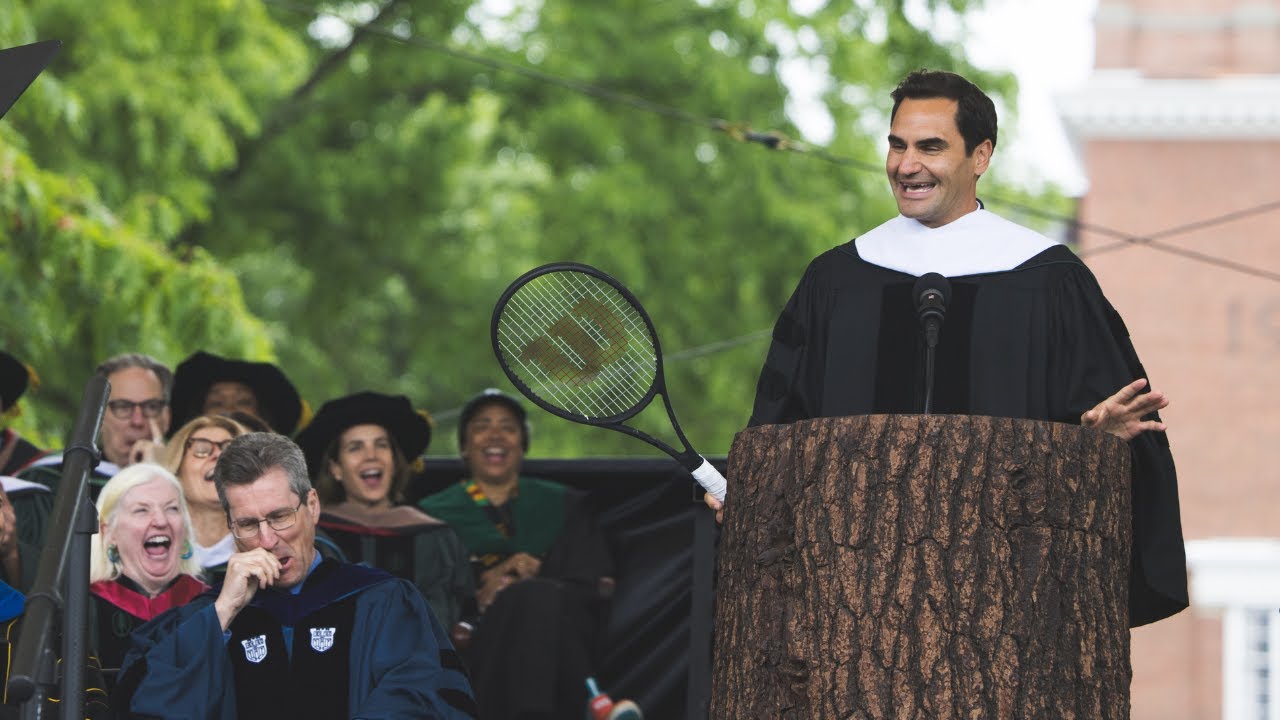
2024 Commencement Address by Roger Federer at Dartmouth
Dartmouth
Roger Federer is a legendary Swiss tennis champion who delivered the 2024 commencement address at Dartmouth College. This is a graduation speech where he received an honorary doctorate degree. (25:04)
TL;DR
- •Effortless is a Myth - Roger Federer emphasizes that success requires intense behind-the-scenes work. What appears easy is actually the result of years of disciplined training and preparation.
- •It's Only a Point - Federer won only 54% of points despite winning 80% of matches. Champions learn to move past failures quickly and stay focused on the next opportunity.
- •Life Beyond Your Court - Success means having a purpose larger than your profession. Federer's foundation work in Africa demonstrates the importance of contributing to something bigger than yourself.
- •Tennis as Team Sport - Individual achievement depends on supportive relationships with family, coaches, and community. Success is built through collaboration, not isolation.
- •Embracing Post-Graduation Uncertainty - Both Federer and graduates face questions about what's next after major life transitions. Not knowing your exact path is normal and acceptable.
Topic Breakdown with Timestamps
Welcome and Opening Remarks - Receiving Honorary Doctorate
0:00 - 3:26Opening the 2024 Dartmouth commencement ceremony, Roger Federer takes the stage after receiving an honorary doctorate degree from President Beilock. With characteristic humor, he acknowledges this is only his second time on a college campus and jokes about becoming "Dr. Roger" while confessing his nervousness about speaking in formal robes rather than his usual tennis shorts. During his campus visit, Federer embraced the Dartmouth experience by playing beer pong (which he learned the college invented), climbing Baker Tower, and sampling local cuisine. The Swiss tennis legend draws warm parallels between the picturesque campus and his native Switzerland, setting a personal and welcoming tone for his address.
Personal Connection to Dartmouth Through Tony Godsick and Isabella
3:26 - 6:02Federer's connection to Dartmouth runs deeper than this ceremonial visit—his business partner and close friend Tony Godsick graduated in 1993, and Godsick's daughter Isabella sits among today's graduates. The tennis champion vividly recalls witnessing Isabella's extraordinary joy upon her Dartmouth acceptance, the same happiness he observes radiating throughout the campus community. In a clever parallel, Federer reframes his recent retirement as "graduating from tennis," acknowledging that like these new graduates, he's navigating uncharted territory while embracing his new full-time role as a father. This shared experience of transition creates an immediate bond between the legendary athlete and the Class of 2024.
First Tennis Lesson - Effortless is a Myth and the Importance of Hard Work
6:02 - 10:20Launching into his first tennis lesson, Federer tackles a persistent myth about his career—that success came effortlessly. He reveals the intense work required to make difficult shots appear easy and candidly discusses his early struggles with mental discipline that opponents ruthlessly exploited. Drawing parallels to academic life, Federer notes how some Dartmouth classmates seemed to achieve straight A's without effort while others burned the midnight oil in libraries. While acknowledging that talent matters, he redefines it to include discipline, patience, and grit. His warning resonates clearly: though people will assume their Dartmouth degrees make everything easy, graduates must never fall prey to that dangerous myth themselves.
Second Tennis Lesson - It's Only a Point and Learning from Losses
10:20 - 15:22The second lesson centers on a fundamental tennis truth: "it's only a point." Federer explains that even elite players lose nearly half their points and must master the art of not dwelling on individual failures. Vulnerability enters his voice as he recalls the devastating 2008 Wimbledon final against Rafael Nadal, where his quest for a record sixth consecutive title crumbled after losing confidence from the very first point—still reeling from Nadal's "crushing" victory at the French Open weeks earlier. Champions, he emphasizes, aren't defined by winning every point but by their resilience in bouncing back, treating each moment as crucial while maintaining the mental fortitude to move forward completely.
Third Tennis Lesson - Life is Bigger Than the Court
15:22 - 19:22"Life is bigger than the court" forms Federer's third essential lesson. While a tennis court occupies merely 2,106 square feet, he always cultivated interests beyond the sport—travel, culture, friendships, and family—to prevent burnout and maintain perspective. His South African mother inspired him to establish a foundation addressing early childhood education in Sub-Saharan Africa, where 75% of children lack preschool access. Over two decades, this work has touched nearly 3 million children's lives, creating humbling experiences that dwarf his athletic achievements. Starting the foundation at just 22, when he felt unprepared for anything beyond tennis, Federer encourages graduates to embrace causes larger than themselves, proving that sometimes taking a leap of faith leads to the most meaningful work.
Roger Federer Foundation Work in Education and Early Childhood Development
19:22 - 20:20Federer praises Dartmouth's educational philosophy, celebrating how students pursue both deep specialization in their majors and broad exploration across disciplines—engineers studying art history, computer scientists mastering German. He honors legendary football coach Buddy Teevens, who wisely told parents their sons would excel as players, students, and people at different times, embodying the college's holistic approach to development. Reflecting on his own journey, Federer acknowledges that while tennis provided countless memories, his off-court experiences—travel, philanthropy, and relationships—prove equally meaningful. This recognition leads to a profound truth: tennis, like life itself, is fundamentally a team sport.
Tennis as Team Sport and Importance of Relationships and Family
20:20 - 22:45Expanding on the team sport concept, Federer reminds graduates that while tennis players stand alone on court, their success depends entirely on coaches, teammates, and even rivals who shape their character. He credits his parents for unwavering support throughout his career and expresses deep gratitude for his wife Mirka and their four children, who share this special moment in the audience. Family, he emphasizes, represents the ultimate team, and he acknowledges the sacrifices graduates' families made to reach this milestone. Unlike his new identity as a "former tennis player," Federer inspires the Class of 2024 by declaring they are not former anything—instead, they are future record breakers, world travelers, volunteers, philanthropists, winners, and leaders carrying forward the relationships and community they've built at Dartmouth.
Closing Remarks and Tennis Technique Demonstration
22:45 - 25:04In a delightful finale, Federer transitions from metaphor to reality, actually demonstrating tennis technique for the graduates. Showing proper grip and footwork, he jokes that "this is not a metaphor, it's just good technique," bringing levity to his conclusion. Expressing genuine gratitude for the honorary degree and the privilege of sharing their special day, he encourages graduates to approach him years from now to remind him they were part of this remarkable Class of 2024. His final words ring with inspiration and warmth: "Go for your shots, play free, try everything, and most of all, be kind to one another"—advice that transcends tennis and speaks to life's greatest game.